



The Real Cost of Skipping Business Clarity
Clarity in business is one of those things people talk about without really explaining. You’ll hear it in motivational speeches. See it printed in planners. Scroll past it in carousel posts. But most entrepreneurs are left wondering what it actually looks like, how you know if you have it, and what to do if you don’t.
Here’s the truth: a business without clarity isn’t a business. It’s a pattern of activity. It’s motion without purpose. It might look productive from the outside, but on the inside, the cracks are hard to ignore.
You’re showing up. You’re working. You’re trying.
But if you’re honest, you’re still not sure what your business really is.
You’ve launched things that didn’t stick.
You’ve rewritten your offer page five times.
You’ve asked yourself whether it’s a niche problem, a marketing problem, or if you’re just doing it wrong.
It’s not always strategy. Sometimes, it’s the absence of definition.
And that’s what clarity gives you.
Clarity isn’t just a mission statement or a one-liner for your bio. It’s the structure under the structure. It’s knowing what your business is, what it isn’t, who it’s for, what problem it solves, how it operates, and what success actually looks like.
Without that, you’ll find yourself:
Changing your message often
Second-guessing your pricing
Launching offers you’re not confident in
Wasting time on tools or systems that don’t fit your model
Struggling to delegate because you’re unsure what tasks belong to what role
This is what we call building in the blur.
And when you build in the blur, nothing sticks.
One month, you’re an expert. Next, you’re starting over.
Your marketing feels inconsistent because your positioning is undefined.
Your backend systems are fragile because your model keeps shifting.
Your growth feels unpredictable, not because you lack skill, but because you’re not anchored in what you’re actually growing.
Let’s be clear: this isn’t a discipline issue. It’s a clarity issue.
You don’t need more effort. You don’t need more motivation. You don’t need to double your hours.
What you need is a defined foundation.
Until you know what your business is, and what it’s not, you can’t structure anything around it.
Not your team.
Not your strategy.
Not your systems.
Not your time.
Not your marketing.
And you definitely can’t scale it.
Growth without clarity turns into chaos.
Structure without clarity becomes a burden.
Systems without clarity waste money.
And visibility without clarity becomes exposure instead of momentum.
You don’t have to stay in the fog. You don’t have to rebuild everything from scratch. But you do need to step back long enough to ask the right questions.
That’s what we’re here to do.
This post is about identifying the most common symptoms of a business that lacks clarity, so you can do something about it. We’re not stopping at the problem. We’re walking through real, usable solutions.
By the time you finish reading, you’ll know how to spot blur in your business. You’ll know what’s causing it, what it’s costing you, and most importantly, how to start changing it, without burning everything down.
Let’s start with one of the most visible signs of an undefined business: the offer that keeps changing.
Symptom #1: You Keep Changing Your Offer, or Your Audience
When your business lacks clarity, one of the first places it shows is in your offer.
You start with one idea.
A few weeks in, you shift it.
A few months later, you realize your audience isn’t responding.
So you pivot.
Then you niche.
Then you rebrand.
Then you change your pricing, restructure the service, or shut it down completely and start again.
If this pattern feels familiar, you’re not alone, and you’re not broken. You’re likely building without definition.
Here’s the trap: in the early stages of business, most of us are encouraged to “test the market.” We’re told to experiment. To see what works. And that’s good advice, until it becomes your entire business strategy.
At some point, testing turns into instability. You’re not learning. You’re circling. You’re chasing certainty in your business by constantly tweaking things on the surface, instead of fixing what’s unclear underneath.
This isn’t an offer problem. It’s a clarity problem.
What This Looks Like in Real Life:
Let’s say you launched a done-for-you service helping coaches set up their backend systems. At first, it felt aligned. But then someone asked about social media support, so you added that. Another person needed branding help, so you added that too. Then a mentor suggested group offers, so you shifted into that model next.
By the time you step back, you’re offering 4 services to 3 different audiences with no clear result, no consistent messaging, and no way to build systems around it.
You’re tired.
Your audience is confused.
Your backend is chaotic.
And you’ve now convinced yourself that you’re the problem.
But you’re not.
Your offer was just never clearly defined, and if the offer isn’t clear, the strategy can’t support it.
Why This Happens:
Most entrepreneurs skip the definition phase because clarity takes courage. It forces you to stop hiding behind options. It asks you to claim something specific. It requires you to say, “This is who I help. This is the problem I solve. This is how I do it.”
That level of specificity feels risky at first. You worry you’ll lose potential clients. You think you need to “help everyone” just to survive. But generality doesn’t scale. Vagueness doesn’t create brand trust. And scattered offers don’t build consistent revenue.
In fact, the longer you avoid clarity, the harder it becomes to delegate, automate, or grow.
Without a defined offer:
Your content lacks direction
Your pricing feels shaky
Your systems can’t support delivery
You keep changing course, even when things are working
The Fix: Create a Business Clarity Statement
Use this framework:
We help [who] solve [what problem] through [how].
It seems simple. But if you try to fill in this sentence and feel stuck, that’s the clarity gap speaking. Most business owners don’t struggle with marketing; they struggle with definition.
Let’s break it down:
Who: Name your people clearly. “Entrepreneurs” is too broad. Are they first-time founders? Digital product sellers? Coaches within their first two years?
Problem: What pain are they living with right now? What are they trying to figure out? What’s frustrating them?
How: Is it a service, a system, a template bundle, a one-on-one process? What do you actually provide?
Here are a few example statements:
We help new founders build their business foundation with legal setup tools, guided planning, and visual templates.
We help overwhelmed service providers streamline their operations with automated workflows and SOP libraries.
We help content creators turn their knowledge into digital products through packaging strategy and brand alignment.
Notice: each of these examples is clear. You don’t have to ask, “What does that mean?” The clarity makes the positioning, pricing, marketing, and structure easier to build.
Still Not Sure Who You Serve?
Try this quick set of reflection questions:
Who do you enjoy working with, and why?
Who gets the best results from your work?
Who is most likely to finish your process, return, or refer?
Who is paying for the value you actually deliver (not just your time)?
Who feels easy to serve, and who drains your energy?
If you can find patterns in your best experiences, you’ll likely uncover the niche you’ve already been serving. From there, you can refine, not reinvent.
What Happens When You Get It Right:
Once your offer is clearly defined, everything else gets lighter.
You stop reinventing your packages.
You stop rewriting your About section every month.
You can write clearer content, automate delivery, and start building consistent systems around what works.
More importantly, you’ll feel more grounded. Confident. Focused.
Because now, you’re not spinning. You’re building. You’re not reacting. You’re guiding.
“A defined offer doesn’t limit your business. It anchors it.”

Symptom #2: You’re Wearing All the Hats—and Still Don’t Know What to Delegate
There’s a moment in every entrepreneur’s journey when the “do-it-all” phase starts to feel less empowering and more exhausting.
In the beginning, wearing all the hats feels like a badge of honor. You're bootstrapping. You’re figuring it out. You’re proud of how much you’re holding down. But over time, what started as ambition becomes dysfunction. You’re the strategist, the executor, the admin, the tech support, and the customer service rep, all rolled into one.
That might work in survival mode. It doesn't work in strategic mode.
If you're doing everything, then nothing is being prioritized. You're operating by reaction, not by design. And more importantly, you're preventing your business from becoming a real entity with structure, flow, and growth capacity.
This isn't just about time management. It's about role clarity. And the deeper truth is this: most entrepreneurs don’t delegate because they don’t know what their actual role is.
The Trap of Undefined Leadership
Here’s what usually happens:
You start off alone, which is normal. You take on all the tasks because that’s what’s required to get things off the ground. But you never stop and ask, “What is my job supposed to be in this business?”
So you just keep going. You learn a little design. You build your website. You send your invoices manually. You schedule social media posts at 11:45 p.m. Then one day, someone tells you to hire a VA. So, you try, but that falls apart because you don’t actually have a process. You try to outsource content, but you can’t explain your brand voice. You try to automate your CRM, but it’s built on systems that don’t match your workflow.
And now, not only are you doing everything, you’re doing it in a way that’s draining you.
This is where a lot of entrepreneurs get stuck. Not because they lack effort, but because they lack definition.
If you’ve never stopped to define the business model you’re building, then your role inside of it will always feel blurry.
What to Do Instead: Define the Vision and the Role
Start by asking the question most people skip:
What kind of business am I building?
Are you building:
A personal brand with you as the center of delivery and voice?
A boutique service model that can operate with or without you?
A product-based business designed for scale?
A hybrid brand that blends coaching, products, and consulting?
Once you answer that, you can define the role you’re meant to hold. Not the role you’re currently stuck in; the role you need in order to grow.
If your business is built around your voice and expertise, you need space for thought leadership, content creation, and high-value delivery. That means your time should not be spent troubleshooting your email sequences or manually onboarding clients.
If you're building an agency model, you need to operate as a director, not a doer. You should be refining systems, managing performance, and driving innovation, not deep in Canva adjusting graphics or rewriting proposals for the third time.
And if you're scaling a digital ecosystem, your role is strategic design and customer experience. You’re the architect. You set the vision. You build the flow. You don’t micromanage the wires.
Run a Weekly Role Audit
To shift into clarity, run this simple exercise:
Track everything you do in one week. Every task, big or small.
Label each task with one of the following:
Strategic (supports your long-term role and business model)
Repeatable (can be documented and handed off)
Misaligned (outside your zone of strength or priority)
Reflect honestly:
What are you doing that doesn’t belong to you?
What roles are you holding that no longer match your business goals?
Where is your time being stolen by tasks you’ve outgrown?
You’ll probably realize that the majority of your time is being spent doing things that block clarity, not build it.
“If you don’t define your role, urgency will define it for you.”

What Happens When the Role Gets Clear
You stop making decisions based on what's urgent and start designing based on what’s necessary.
You create SOPs without overthinking. You delegate with ease because you know what needs to be off your plate. You start planning instead of pivoting. And your business finally starts to feel like a structure, not just a series of tasks you’re responsible for every day.
This is the beginning of operational clarity. It’s not about hiring fast or automating everything. It’s about knowing what your business needs from you, and refusing to stay in roles that no longer serve where you’re headed.
Symptom #3: Your Structure Doesn’t Match Your Vision
There comes a point when what you’ve built no longer fits what you’re building toward.
You have the vision. You’ve outgrown the starter tools, the patchwork systems, and the pieced-together workflows, but you haven’t fully transitioned into something that supports where you’re going. And now, everything feels harder than it should.
You’ve grown, but your business structure hasn’t caught up. And that gap is costing you.
At first, it shows up as friction.
Tasks take longer.
Client onboarding feels clunky.
Deadlines stack up.
Your calendar feels crowded, and yet progress feels slow.
Then, it starts to feel like burnout.
You’re working more hours just to keep the wheels turning.
You hesitate to promote your services because you know the backend isn’t ready.
You avoid looking too closely at your systems because you’re not sure what’s broken or how to fix it.
This is where many entrepreneurs get stuck. They assume they just need to work harder or add more structure. But more isn’t the answer. Compatibility is.
If your internal systems are built for a business you no longer run, you’re going to feel the drag, no matter how skilled or motivated you are.
Why This Happens
In the beginning, speed and flexibility matter most. You’re validating your offer. You’re trying to land your first few clients. You’re doing what works in the moment.
But what works at the start rarely supports sustainable growth. The patchwork tech stack, the lone spreadsheet doubling as a CRM, the manual onboarding emails; these makeshift solutions can hold up when the workload is light and expectations are minimal. The problem is, most business owners keep operating with those same systems long after their business has evolved.
Why? Because rebuilding feels overwhelming.
You don’t want to pause revenue-generating activity to clean up what’s behind the scenes.
You’re not sure where to begin.
And truthfully, part of you is afraid that if you stop to restructure, everything might fall apart.
But if you don’t address it, that’s exactly what starts to happen anyway, slowly, and then all at once.
What to Do Instead: Conduct a Structure Alignment Audit
This doesn’t need to be complicated. You can start by assessing four core areas of your business structure:
Delivery Systems
How do you fulfill your offer?
Is the process automated, documented, and scalable?
What feels slow, manual, or overly complex?
Marketing Systems
How do new people discover you?
Is your content consistent and strategic, or reactive and last-minute?
Do you have a lead process that moves someone from interest to action?
Client/Customer Experience
What does it feel like to work with or buy from you?
Are your onboarding, communication, and follow-up processes smooth and clear?
Internal Operations
Do you have workflows for recurring tasks?
Are your documents, files, and assets organized and easy to access?
Where are the bottlenecks or breakdowns happening most?
For each area, ask:
What’s outdated?
What’s fragile?
What’s missing?
You don’t need to fix everything at once. Start with the system that causes the most frustration, delay, or confusion, because that’s where clarity is most urgently needed.
The Mindset Shift: Structure Isn’t Restriction; It’s Support
One of the biggest misconceptions about business structure is that it limits creativity or flexibility. But the right structure does the opposite. It gives you freedom.
Freedom to scale without stress.
Freedom to delegate without losing quality.
Freedom to promote your business without wondering if it can actually handle the growth.
Structure is how you protect your energy, your time, and your clients' experience.
It’s about creating flow around what matters most.
“You don’t need to work harder. You need the right structure.”

Signs You’re Due for a Structural Upgrade
You’re making more revenue but feel more disorganized than ever
You avoid launching because your backend isn’t ready
You say “yes” to fewer opportunities because your system can’t support the volume
You’re overwhelmed by the thought of delegating because nothing is documented
You feel like you’re operating inside a machine that no longer fits who you are
These aren’t just operational issues. They’re structural signals, and they’re pointing you toward a deeper need for clarity and support.
Before You Go…
If you’ve ever felt like you’re running a business that looks good on paper but feels chaotic behind the scenes, you’re not alone. Many entrepreneurs are stuck in cycles of ambition without structure, grinding toward growth without a scalable foundation.
But what if your next level didn’t require more hustle, just smarter structure?
Every post inside the VTG Vault is designed to help you think differently about how you build, operate, and lead your business. We don’t offer quick fixes or recycled advice. We offer clarity, strategy, and structure you can actually use.
🧠 Want to stay in the loop?
Subscribe (it’s free) to get strategy breakdowns, signal-rich Notes, and behind-the-scenes insights you won’t find anywhere else.
💼 Need a way to turn that clarity into a real plan?
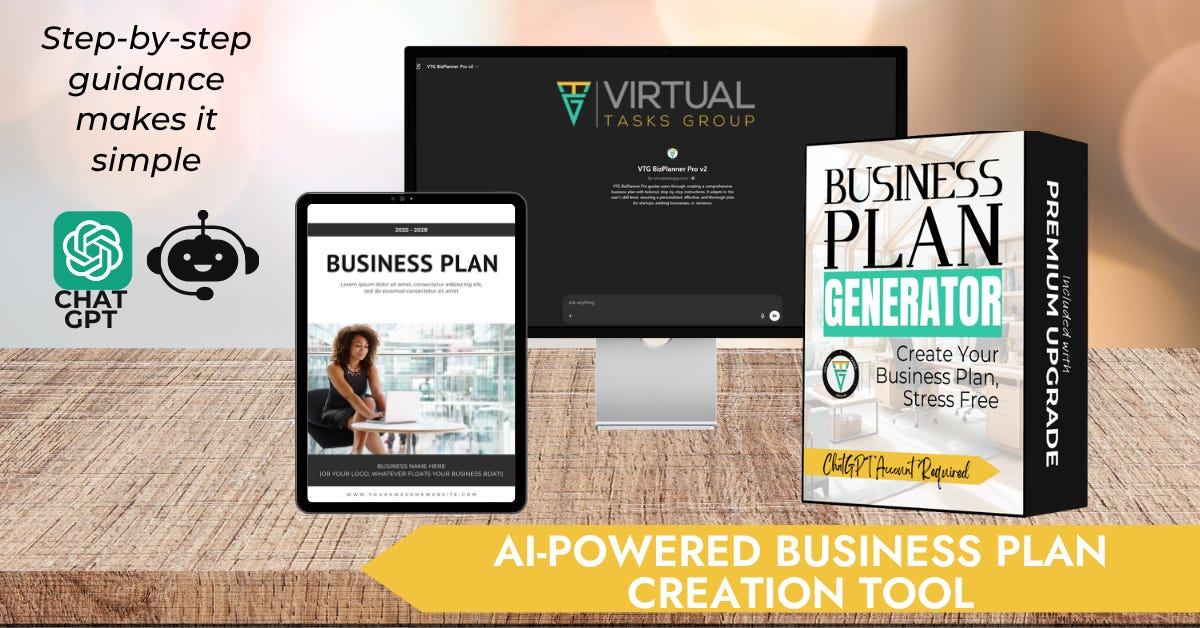
Grab the Business Planning Toolkit—a powerful resource designed to help you map out your offer, audience, structure, and goals all in one place.
No more scattered notes or half-finished documents. This is the tool serious entrepreneurs use to build businesses with intention and staying power.
→ https://learn.virtualtasksgrp.com/vtg-bizplanner-pro-v2-gpt-bundle


