


When Your Business Lives in Your Head
Right now, your business runs on what you remember.
You remember which client needs what. You remember how you onboard people. You remember the steps, the shortcuts, the exceptions, the things you only explain once. If someone asked how your business works, you could explain it out loud. You might even explain it well. The problem is that once the conversation ends, it all goes right back into your head.
That makes you the system.
Most solopreneurs do not realize this is happening because it feels normal. You wake up, check messages, respond, adjust, handle today’s priorities, then do it again tomorrow. The business keeps moving, so it feels functional. Under the surface, every decision still runs through you. Every process depends on your memory. Every delay traces back to your availability.
That is what it means to be the bottleneck in your own business.
This shows up in small ways first. Repeating the same instructions. Answering the same questions. Rebuilding workflows that already exist, just not anywhere visible. It shows up when you want help but cannot explain the work without starting from the beginning. It shows up when you think about stepping away and immediately start listing everything that would stop.
What matters most is whether the business knowledge exists outside your head.
Businesses that last do not rely on memory alone. They rely on systems that hold decisions, steps, and flow outside the founder’s head. That can be a documented process, a shared folder, a database, a simple SOP, or a basic workflow tool. The format matters less than the fact that the business knowledge exists somewhere other than you.
When the business lives only in your head, it limits how far it can go. It limits how much rest you get. It limits who can support you. It limits what you can build next.
You do not need to be more organized. You do not need to work longer hours. You need the business to stop living inside you.
That shift changes everything.
If you’re tired of being the entire ‘system’ in your business, VITA is where we turn your chaos into a simple operating playbook with you. Click here to see how the community works.
Why So Many Businesses Are Built to Survive, Not to Hold Systems
Most businesses start the same way. Someone needs income. Something shifts. A door closes. A new path opens. The business begins because doing nothing is not an option.
For many founders, especially self-funded ones, the early focus stays tight. Bring in revenue. Serve the client. Solve the problem in front of you. That approach works. It keeps money coming in. It keeps the business alive.
The data reflects this reality.
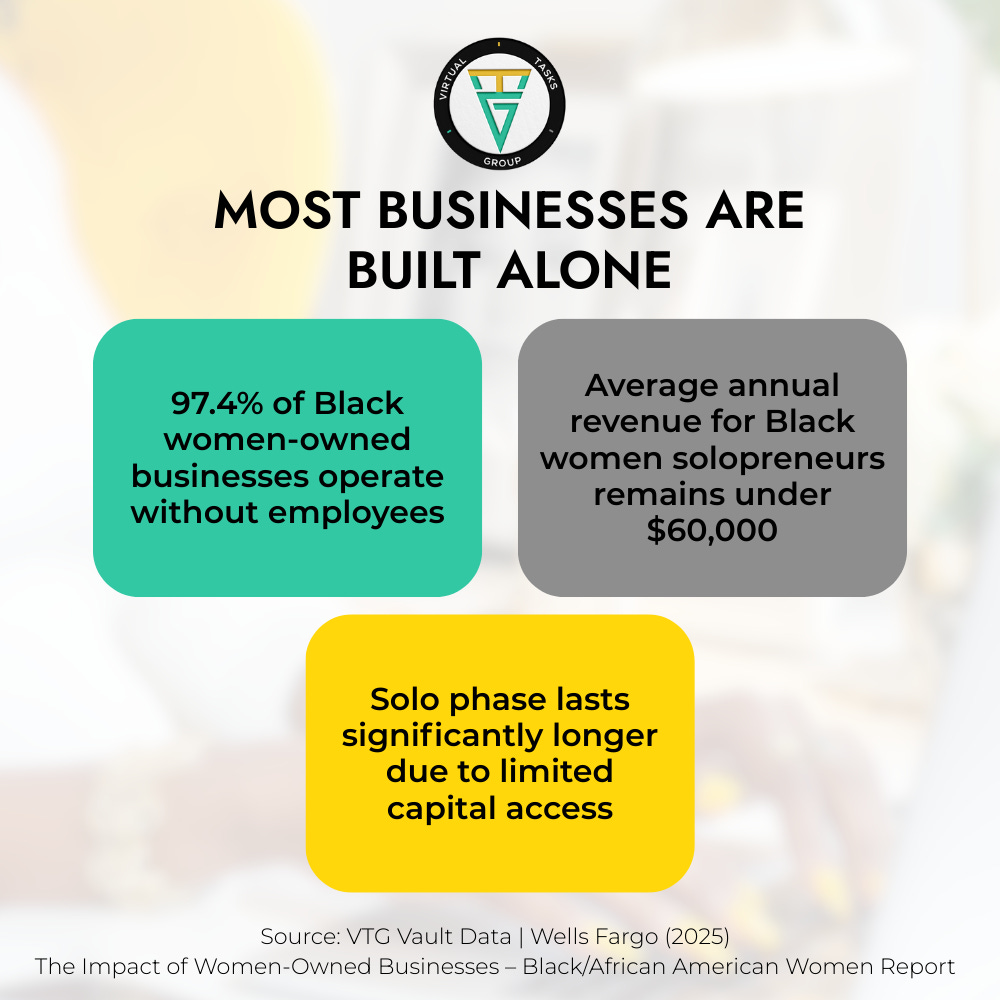
Recent reports show that nearly 97 percent of Black women-owned businesses operate without employees, staying in solo mode for years. Average revenue for many of these businesses stays under $60,000 annually, which leaves little room for paid help, advanced tools, or outside support. When funds are limited, structure becomes something you plan to handle later.
Later rarely comes.
So the business grows around urgency. Client delivery happens first. Admin tasks get squeezed in. Processes stay informal. Instructions live in conversations. Decisions live in memory. The work still gets done, but it travels through one person.
That person becomes the system.
Research on small and micro businesses shows they operate at about 60 percent of the productivity level of larger companies. The gap is not effort. The gap is structure. Larger businesses rely on documented processes and shared systems. Solo businesses rely on recall. That reliance creates extra labor that never shows up on a to-do list.
This pattern explains why founders repeat themselves so often. It explains why training help feels harder than expected. It explains why stepping away feels risky. When nothing is written down, the business only works when you are present.
Studies also show that over 60 percent of solopreneurs describe themselves as the bottleneck in their business. Tasks slow down because one person holds all the information. Decisions pile up because no system catches them. Progress depends on energy and memory instead of structure.
For self-funded and excluded founders, this phase lasts longer.
Fewer financial buffers mean fewer pauses to document. Fewer systems mean fewer handoff points. Fewer resources mean more reliance on personal tracking. Over time, the founder becomes the archive, the operations team, and the backup plan without meaning to.
Seeing and recognizing this pattern matters.
The weight people feel has a source. It comes from how the business was built under real conditions. Once that is understood, the pressure shifts. The conversation moves toward systems, documentation, and shared knowledge. That shift opens the door to sustainable change.
The Hidden Labor That Keeps Your Business Running
A lot of the work you do never gets named.
It does not show up as a task. It does not come with a deadline. It lives in your head and follows you through the day. Remembering how each client likes things done. Rebuilding a process because the last version was never written down. Making judgment calls you already made last month because nothing captured them the first time.
This is internalized labor.
It shows up when onboarding feels harder than it should. You know the steps, but they live in your memory instead of a document. It shows up when client conversations require mental prep because the history is not stored anywhere else. It shows up when decisions get redesigned instead of recorded, which turns yesterday’s solution into today’s problem all over again.
Research puts numbers to this experience.
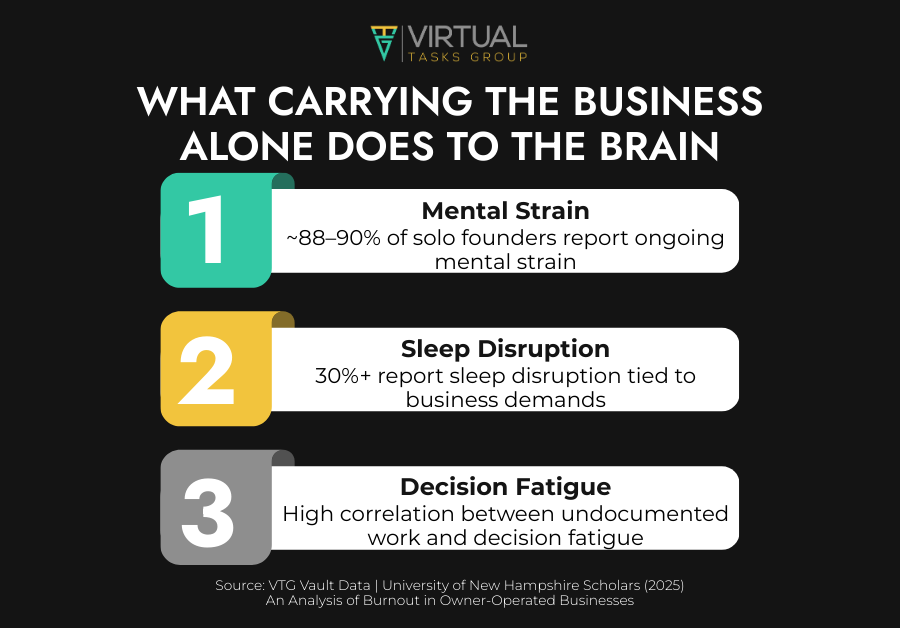
Research on solo business owners shows that nearly nine out of ten report ongoing mental strain tied directly to running their business alone. More than one-third report sleep disruption and difficulty staying focused during the day. That connection matters because it mirrors what many founders live with quietly. When every task depends on remembering steps, context, and outcomes, the brain never really rests. Work continues long after the laptop closes. Thoughts loop. Decisions replay. Energy thins out.
This is not abstract. It shows up in real moments. Late nights spent retracing work. Early mornings catching up because yesterday ran long. Trying to concentrate while carrying unfinished decisions in your head. The business keeps moving, but it moves through a tired nervous system. Over time, that constant mental demand slows thinking and shortens patience, even for people who love what they do.
For self-funded and excluded founders, this labor stretches out longer.
Data shows that nearly half of solopreneurs report going at least one month without income in a given year. That reality limits experimentation. Fewer financial buffers mean fewer chances to pause and document. Fewer systems mean fewer ways to share responsibility. The founder becomes the holder of context because there is no alternative place for it to live.
This is where exhaustion enters the picture.
You are exhausted because you are carrying the work of an entire infrastructure layer by yourself.
That layer includes process design, memory storage, decision tracking, and operational flow. In larger businesses, those responsibilities live across systems and teams. In solo businesses, they collapse into one person. The work does not disappear. It concentrates.
Once this labor becomes visible, something important changes.
The problem stops feeling personal. The work gains shape. The load can be named. From there, redistribution becomes possible. Processes can be written once. Decisions can be stored. Client context can live somewhere other than your brain.
You cannot redistribute what you cannot see.
Seeing it is the beginning of relief.
This is exactly what we work on inside VITA: mapping what’s stuck in your brain and turning it into a system your business can actually run on. Join us here.
Structure as Business Relief: Giving Your Work Somewhere Else to Live
A lot of founders hear the word structure and tense up.
Structure often gets introduced as something extra. Another layer. Another responsibility. Another thing to manage when time already feels tight. That framing makes structure feel heavy before it ever gets helpful.
Here is a simpler way to understand it.
Structure is somewhere for the business to live outside your body.
When the business only exists in your head, you carry the memory. You carry the decisions. You carry the flow of how things work. Structure takes that weight and places it somewhere else. A document. A system. A shared folder. A simple workflow. The format matters less than the result.
Research backs this up in practical ways.
Studies on small businesses that adopt even basic digital systems show consistent gains in efficiency and reduced mental strain for founders. OECD data shows that cloud-based tools and documented workflows improve productivity for small businesses in over 70 percent of measured cases. Founders report fewer repeated decisions and smoother handoffs, even without hiring staff. The work still exists. The work just stops living inside one person.
That is what structure actually does.
It holds memory so you do not have to remember everything.
It holds decisions so you do not have to rethink them every time.
It holds process so work can move without your constant involvement.
This is where the shift happens.
Structure removes weight. It shortens the mental loop that keeps work running in the background of your day. It creates space between you and the business so your brain can rest while the work continues. That space changes how you show up. It changes how long you can sustain the work. It changes what feels possible next.
This solution does not look like a checklist.
It does not look like a productivity sprint.
It does not require a personality shift.
It does not ask you to become someone else.
It starts with deciding that your brain is no longer the storage unit for the business.
Founders who adopt this mindset begin documenting one decision at a time. They capture a process once instead of explaining it repeatedly. They build simple systems that match their capacity instead of copying what larger companies do. Over time, the business becomes easier to manage because the weight is shared with tools and systems designed to hold it.
The solution is not doing more systems.
The solution is letting systems carry what you have been carrying alone.
That is where relief enters the picture. That is where sustainability starts to feel real.
What Changes When the Business Stops Living in Your Head
The first change is quiet.
You notice it when a familiar task comes up and your brain does not scramble. The steps already exist somewhere. You are not rehearsing the process before you start. You are not double-checking yourself mid-task. You simply follow what is already been decided.
That is what externalized load looks like in real life.
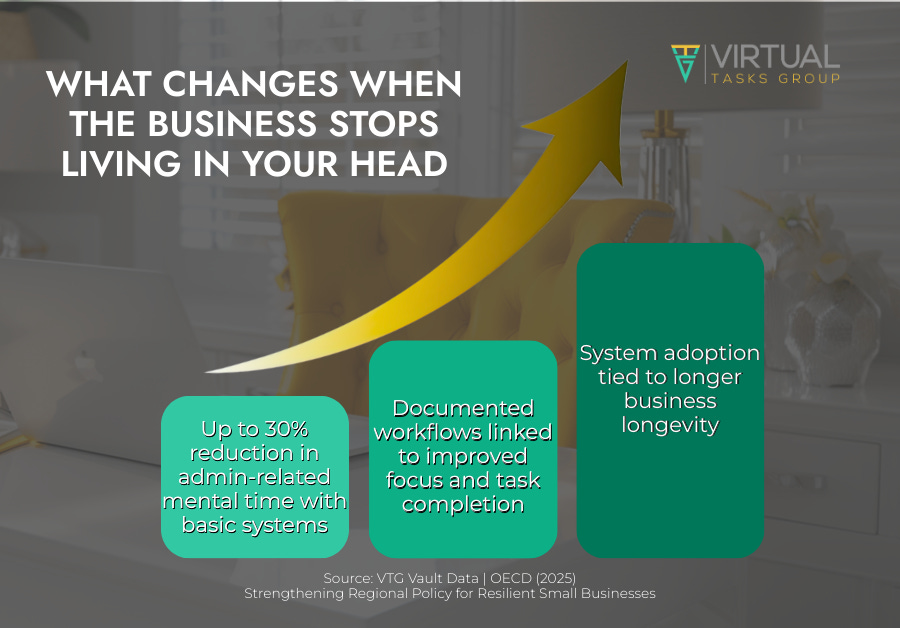
Founders who move even a small amount of information out of their head report fewer repeated decisions and shorter workdays, even when revenue stays the same. Research on small business systems adoption shows that documenting processes and using basic digital tools reduces time spent on administrative thinking by up to 30 percent. That time does not disappear. It gets returned to the founder as usable energy.
Another change shows up in how work ends.
When decisions are stored outside your memory, work stops looping. You do not replay conversations while making dinner. You do not lie awake retracing steps. The business has a place to rest when you step away. That separation matters. Studies on solo business owners show that founders with documented workflows experience improved sleep quality and better focus during working hours. The mind responds quickly when it no longer has to hold everything at once.
This shift does not require rebuilding your entire business.
Pacing matters here.
Most founders who experience relief start small. One process written down. One decision captured. One workflow recorded. The goal stays simple. Give the business somewhere else to live. Over time, those small moves stack. The business becomes easier to manage without becoming complicated.
Choice plays a role too.
Structure works best when it matches your capacity. Some founders prefer written SOPs. Others use simple checklists or shared folders. Some rely on workflow tools. Others use voice notes turned into documentation. The format stays flexible. The intention stays steady.
That intention supports sustainability.
Data from long-term small business studies shows that founders who invest in systems early tend to stay in business longer and report higher satisfaction with their workload. Longevity improves when the business no longer depends on constant personal effort to function. Capacity grows when energy is preserved instead of spent tracking details.
This is where the emotional shift lands.
Relief is not something you earn after success.
Relief supports the ability to sustain success.
When the business stops living inside your head, you gain space. Space to think. Space to rest. Space to choose what comes next. That space does not slow the business down. It steadies it.
That steadiness is what carries work forward for the long run.
When the Business Finally Has Somewhere Else to Live
By now, one thing should feel clear.
What you have been carrying was never meant to stay inside one person.
Across industries, research shows that most solo founders operate for years without shared systems, documented processes, or decision records. Nearly half report income gaps during the year. Many report ongoing sleep disruption tied to mental carryover from work. Those numbers matter because they confirm something many people have felt privately. The strain does not come from a lack of ability. It comes from how the work has been held.
When a business relies on memory, the founder becomes the container. Every decision, process, and exception stays personal. Over time, that setup blurs the line between work and self. The business follows you into conversations, rest, and quiet moments. That weight can feel personal because it lives so close to you.
The truth sits somewhere else.
This experience comes from structure that never had a place to land.
Once the business has somewhere else to live, the pressure eases. Knowledge becomes shareable. Decisions stop repeating. Processes exist without constant explanation. The work still matters, but it no longer occupies every corner of your mind.
You were capable long before you read this. You are capable now. The issue has always been placement, not strength.
Here is the language worth keeping.
Your business needs space.
Your brain deserves relief.
Your work deserves systems that can carry it forward.
Nothing needs to change tonight. Nothing needs fixing in this moment. This understanding alone creates room to breathe. When the business stops living only inside you, everything about how you carry it begins to shift.
Let that be enough for now.
You Are Invited!
If you read this and thought, ‘This is me,’ VITA was built for you. Join the community and get the structure, accountability, and support to stop being your own ops team.
VITA is a working community built around helping founders move their business out of their heads and into systems that can actually support them. Inside, the focus stays practical. Documented workflows. Decision frameworks. Infrastructure you can reuse instead of rebuilding every time. Nothing flashy. Nothing performative. Just real tools and shared thinking for people building without excess support.
You do not have to show up with everything figured out. You do not have to commit to anything right away. You can simply come by, look around, and see if the conversations and resources feel useful for where you are right now.
VITA is here to give the business somewhere else to live, so it does not have to keep living inside you.
You are welcome to visit whenever you are ready.
The VTG Team
Hit reply and tell me: What's the one part of your business that only exists in your head right now?


